
Housing Costs? Loneliness? Intergenerational Housing could be a solution!
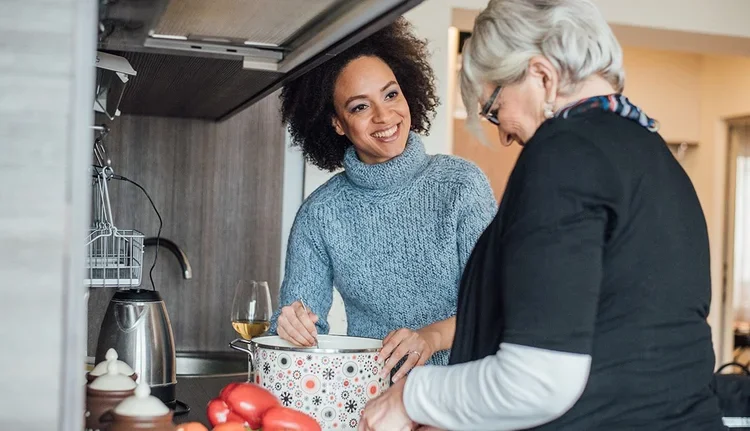
Young Woman Helping Older Woman with Cooking
It’s funny how old ideas sometimes come back around in a fresh form. Across time, communities have generally folded all ages in their households, with grandparents and extended family forming a matrix of shared household responsibilities and care. Somehow, the silo-ed American family in their single family dwelling took over the U.S. landscape with the idea that we all can be happier if we have our own space.
Affordable Housing & Social Support
It turns out that this has not been particularly good for anyone, including our elderly population. The Covid pandemic parenthesized in dramatic ways the effects of social isolation on declining mental and physical health. At the same time, housing shortages and rising rents have made things difficult for young adults looking for decent housing. In a trend that has been gaining momentum since the 1990’s, a number of individuals and groups have worked towards an alternative vision that brings together older adults and younger people in some surprising and innovative ways. A recent study by Generations United, LeadingAge, and Harvard’s Joint Center on Housing Studies outlines multiple intergenerational housing models and encourages a social movement in this direction. One goal of such efforts is to address both the shortage of affordable housing and the pandemic of loneliness that is impacting our senior population.
Intergenerational Community Models
Consider the H.O.M.E. Project in Chicago whose housing mission recognizes that “living in a community is as important as food and shelter.” They offer affordable housing for seniors with a number of units reserved for young families and for support staff who facilitate community events and activities. Arizona State University has created a 239-unit tower on its campus for those over sixty-two, putting older adults right into the middle of the action. In Kansas City, MO Pemberton Park for Grandfamilies supports grandparents raising their grandchildren, providing both after school support for youth and continuing education for seniors. There are also housing models that encourage older adults, particularly in college towns, to consider opening up a room or space in their home for students looking for housing. Some of the terms you might encounter include:
Home Sharing - An older adult homeowner offering a private living space to a younger non-relative tenant who might exchange services in lieu of part or all of rent.
Intergenerational Cohousing - Communal living for all ages with a range of housing styles and sizes with facilities and public spaces that encourage intergenerational mingling. An example of this type of co-housing in Orange County, NC can be found at Arcadia.
Intergenerational Shared Sites - Intentional programs that pair young and older generations in the same physical location with activities intended to bring them together. This might including living spaces as well as housing in proximity to a day care center or youth program with organized programs to encourage that connection.
Related Generations Under One Roof - Living arrangements that include three or more generations of relatives living together and sharing daily tasks and co-support.
In a recent article published in The Daily Tarheel, UNC’s student newspaper, journalist Anna Gage describes the 2024 student housing crunch that left 900 students on a waitlist for on-campus housing. She encourages UNC-Chapel Hill to consider looking at a Canadian company who has created an online match program called SharedSpace that helps older adults interested in home sharing and local college students in need of affordable housing to find each other.
Spiraling Costs
Intergenerational housing has also taken off in urban areas where spiraling costs can make it difficult for young professionals to find reasonable rents. Local non-profits can match seniors with space to share in expensive markets with young adults needing a shoe-in. The National Shared Housing Resource Center provides a directory of such organizations around the country. Not only does the intergenerational home sharing help with costs but it also can be a source of help with maintenance, companionship and chores.
With the Baby Boomers advancing into their later years, these innovations offer creative ways to keep older people in their own homes, connected socially and sharing their accumulated knowledge and resources. It also offers the younger generation a step up and forward in what can be a challenging housing climate.
Whatever your stage of life, remember you can trust the professional guidance and support of our legal team at Hillsborough Wills & Trusts to help you see the possibilities. We will be happy to serve you at 919-245-8440 or through our website at https://hillsboroughwills.com/contact.